
How CouncilTracer works
CouncilTracer answers questions about City of Mitcham's public record. It works differently from a search engine — and it works best when you ask it differently. Two minutes here will get you noticeably better answers.
How to ask
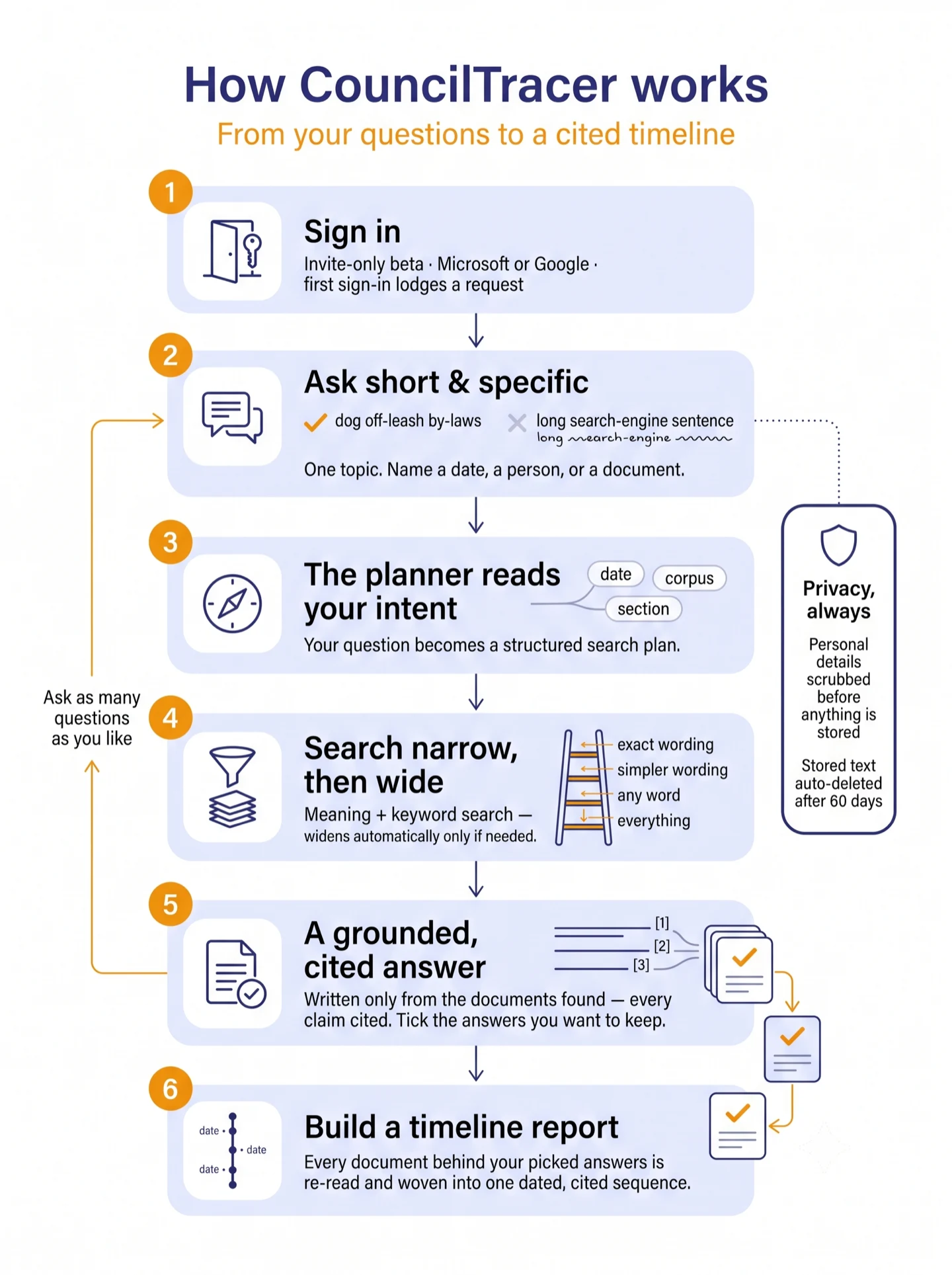
Short and specific beats search-engine-style.You don't need to stuff a question with every keyword you can think of — a planner reads your question first and works out what to search for. Long, winding sentences just give it more to misread.
- Name the thing.A date (“June 2025”), a councillor, a place, or a document collection (“the dogs by-law”, “the Community News”, “an information session”) lets the planner go straight to the right shelf.
- One topic per question.Ask “What did Council decide about the Blackwood land sale?” and then follow up — the conversation remembers your recent answers, so “did it have budget implications?” works as a follow-up.
- Don't over-widen to be safe. The tool narrows first and widens automatically: if a tight search comes back thin, it retries with simpler wording, then any-of-the-words, then the whole document collection — on its own. You never pay for being specific.
Works well: “dog off-leash rules in the by-law”
Works less well: “I was wondering what all the rules and regulations might possibly be for dogs being off the leash anywhere in the council area”
Watch it think
Every answer shows its working. The “How I read your question” panel shows the planner's parse — the search terms, dates, and document collections it chose — and the search trail shows every retry the search made, including when and why it widened. If an answer misses, the trail usually shows you exactly which word to change. On the home page you can also pre-narrow a question with the “Search in”selector above the ask box — it's a starting point, not a wall.
How we identify and rank sources →Two independent searches — one on your words, one on your meaning — and how their agreement becomes confidence, with dogs off-leash as the worked example.What happens to your question
- The planner reads your intent. A language model turns your question into a structured search plan: the topic to look for, plus facets like dates, the document collection, and the report section.
- Hybrid search, narrow first. Meaning-based search and keyword search run together over the council's documents, filtered to the plan's facets.
- The ladder widens automatically. If the narrow look comes back thin: simpler wording → any-of-the-words → the whole collection — only as far as needed, and it tells you when it does.
- The answer is written only from what was found.Every claim carries a numbered citation back to the exact source document — and usually the exact page. Nothing is answered from the model's general knowledge.
- Records are computed, not composed. Voting records, register listings and similar complete records come from code running over structured data mined from the minutes — the model summarises them but never invents the list.
- Answers can become a timeline report. Ask as many questions as you like, then pick the answers that matter and click Create timeline report above the conversation — every source document behind them is re-read from the record and written into one chronological, cited account.
Your privacy while you ask
The raw text of your question is never written to a file, a log, or a database — it's handled only in working memory while your answer is generated. Before anything is stored, an automated personal-information redaction filter (running on our own hardware) replaces names, addresses, phone numbers and similar details with typed placeholders; if the filter is ever unavailable, the question text is withheld entirely rather than stored unfiltered. Everything stored is automatically deleted after 60 days. Full detail: Privacy policy.
Getting access
CouncilTracer is in early access — just sign in to start. Enter your email and we'll send you a 6-digit code (no password, and no link for your email security to mangle), or use a Google account. Sign-in always happens on the provider's own page, so CouncilTracer never sees, asks for, or stores a password. Sign in.
See also: governance, accuracy & limitations · FAQ · what we're tracking · privacy policy · scraping & transparency